Work SITIMM
Case study · May 2025 to now
Running a union's platform with a team of AI agents.
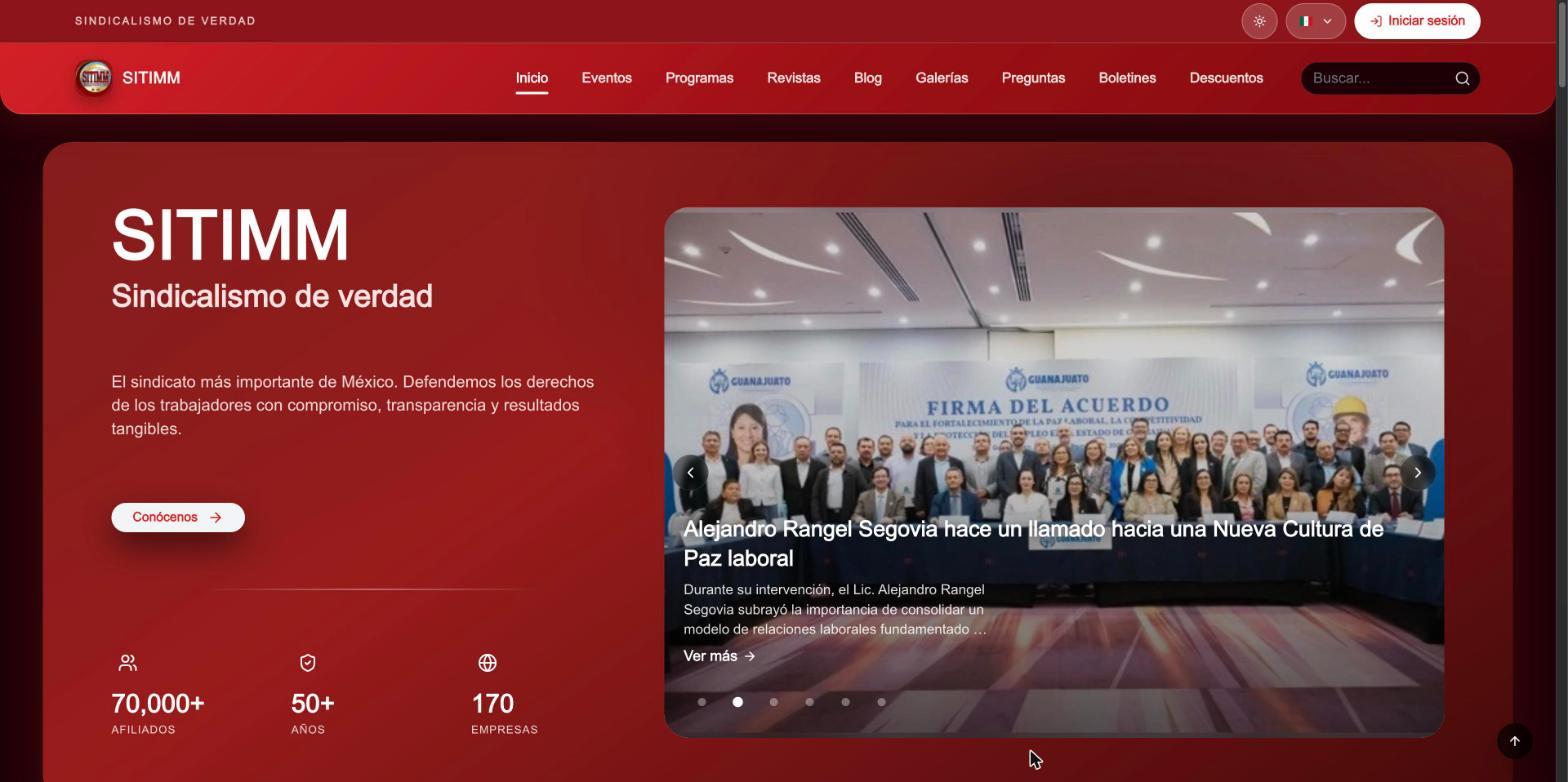
SITIMM is a Mexican union of 70,000 members in 170 companies. Since May 2025 I've led its website, mobile app, admin panel and API as the only human engineer. I direct parallel AI agent sessions and hold them to the same gates I'd ask of a senior team.
- My role
- Lead engineer: architecture, scope, review, every merge
- Team
- Me, plus 5–6 parallel AI sessions; a second model reviews
- Surfaces
- Web, iOS and Android app, admin panel, API, shared types
- Stack
- FastAPI, PostgreSQL, Next.js, React, React Native
Screens
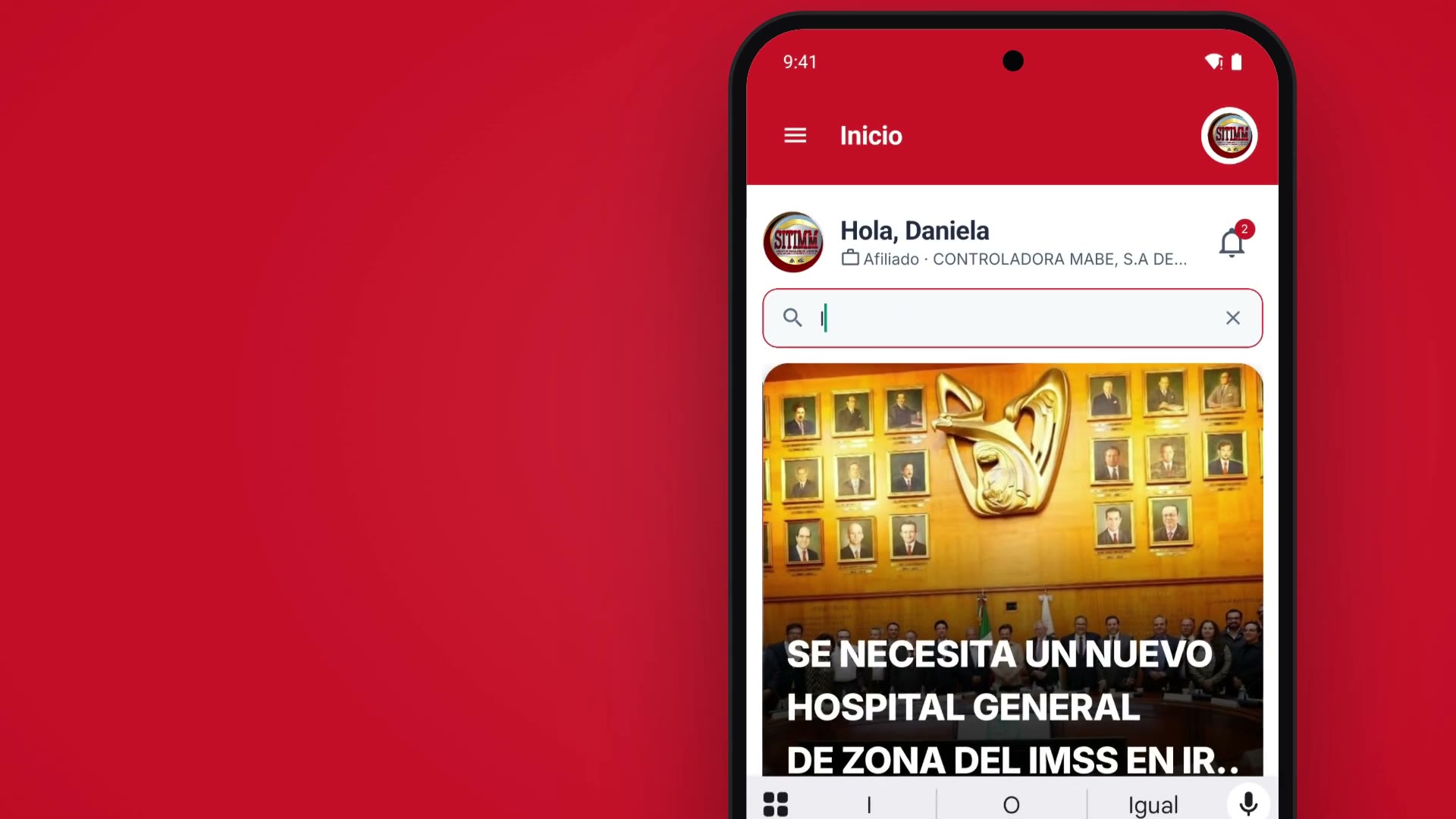
Transcript in English
- 0:00, opening. “I'm Daniela. I'm a SITIMM member.” A phone shows the app's splash screen with the union's seal.
- 0:04, home. “Everything important from the union, on the first screen.” The app greets Daniela by name, shows news and magazines up front, and searches all of SITIMM for “IMSS”.
- 0:15, magazines. “Keep up with union news in our weekly magazine, SITIMMFORMA, complete on your phone.” She opens issue 45 in the built-in reader and jumps through its index.
- 0:29, consultations. “Your union advisor, one message away: IMSS, INFONAVIT, AFORE or FONACOT, followed through until your case is closed.” She asks about IMSS and an advisor replies in a live chat.
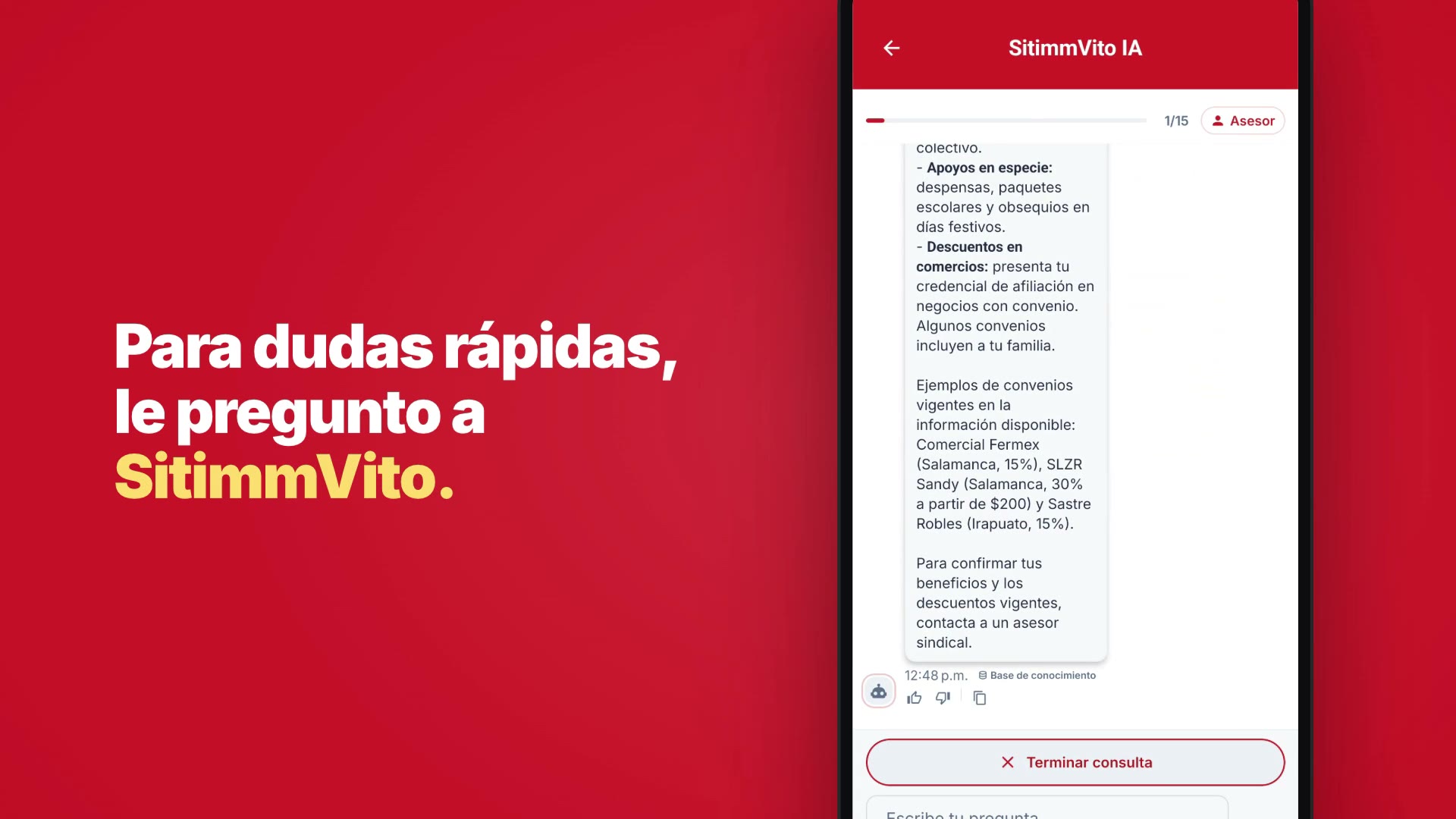
- 0:53, SitimmVito AI. “Answers right away, whenever you need them, from the union's own information.” She taps a suggested question and the assistant answers.
- 1:01, day and night. “I use it day and night.” The app switches to dark mode.
- 1:06, announcements. “The union's official voice, the moment it's published.” General notices and the ones for her company.
- 1:15, discounts. “Member benefits: 114 businesses with discounts in 6 cities.” She filters by city, opens a business in Celaya and sees its hours and a map.
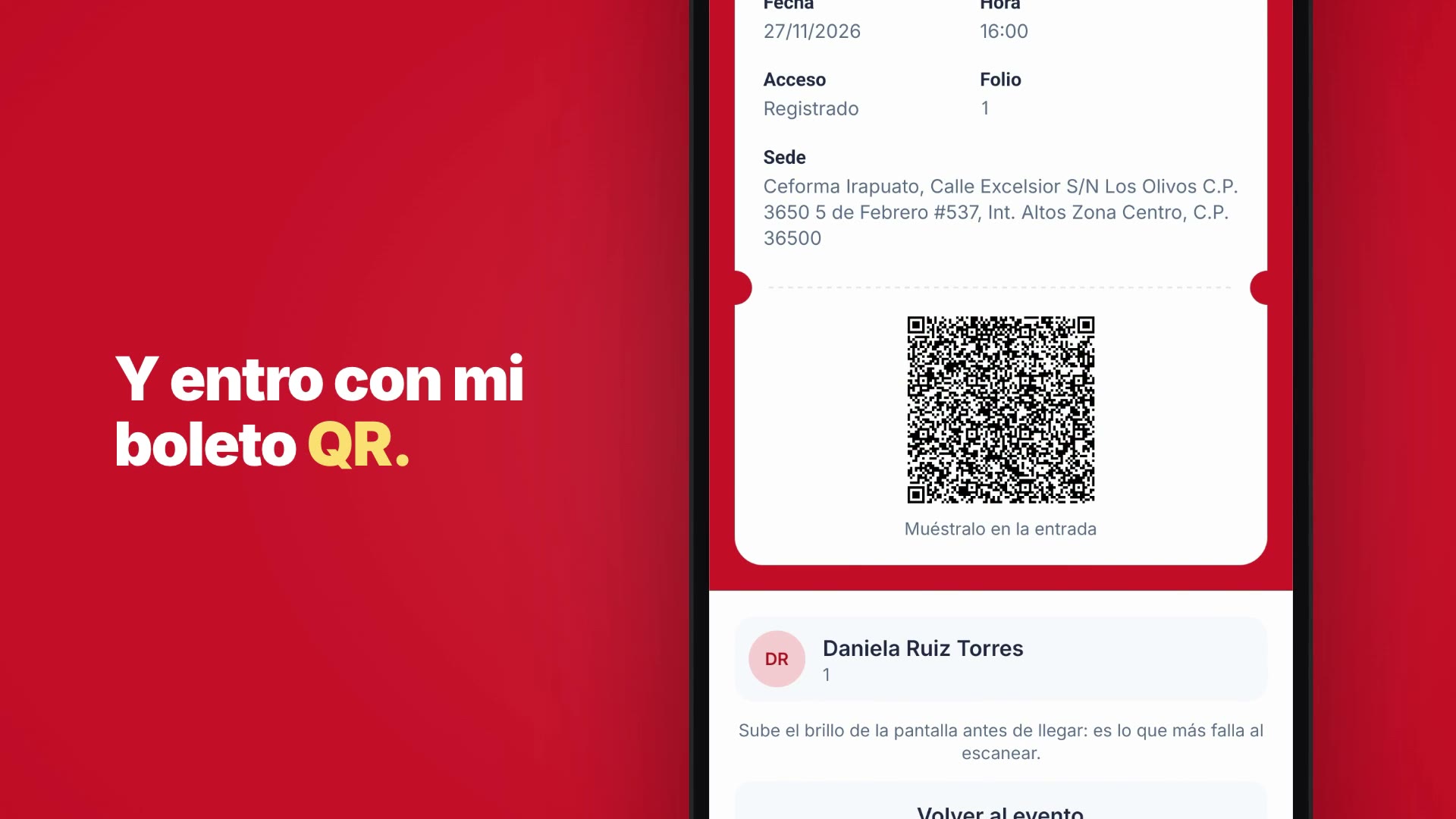
- 1:31, events. “Courses and workshops: sign up in a few steps and get in with your digital ticket.” She signs up and gets a ticket with a QR code.
- 1:50, in your language. “Available in 8 languages.” The same screen in Spanish, English, Chinese and Japanese.
- 2:00, close. “Yo Soy SITIMM. Sindicalismo de verdad.” (“I am SITIMM. Real unionism.”) QR codes for the App Store and Google Play.
The problem
Members needed news, events, benefits and their union services on their phones. The union had a legacy backend, no product team, and one engineer: me.
The constraints were real. One 16 GB laptop shared by every agent session. No paid CI: GitHub Actions has been off since September 2026, so every quality gate runs locally. And no room for a bad release on an app that 70,000 people can install.
What I owned, what the agents did
Me
- Architecture, contracts between the five repos, and scope
- Writing and ordering the tickets
- Reviewing and merging every pull request
- Releases, and QA on real phones
- The rules every agent follows, and changing them after each incident
The agents
- Write code and tests, each in its own git worktree
- Run the local gate before every push
- Review each other: a second model checks the first
- Draft docs and handoffs between sessions
- Never merge or deploy without my explicit OK
How a change ships
- TicketScoped in Jira, one at a time per session.
- WorktreeThe agent works in its own checkout, never the shared one.
- Code and testsTests come with the change.
- Local gateLint, types, tests, coverage of touched lines. One heavy job at a time on the machine.
- Cross-reviewA second model reviews and says what it actually read.
- My review and mergeNothing reaches main without me.
- DeployAPI by continuous deployment; web and panel on Netlify; app through the stores.
Guardrails, and the incident behind each one
Every rule here exists because something broke. That's the part of working with agents nobody shows.
| Rule | What happened | How it's enforced |
|---|---|---|
| One worktree per agent | Jul 2026: two sessions shared one checkout. One switched branches under the other's build and mixed two tickets on one branch. | Writing agents get their own git worktree. The shared checkout is read-only. |
| Measure memory before heavy work | Sep and Nov 2026: the laptop rebooted twice under parallel pushes, test suites and a video render. In-flight work was lost. | Under 40 % free memory, stop and ask. One heavy job at a time through a machine-wide lock. |
| No lock inside a lock | Nov 2026: a push run under the lock waited on its own pre-push check and held the machine for 8 hours. | An environment flag tells nested steps the lock is already held. |
| Real installs in worktrees | Nov 2026: three pushes went out with no hooks because dependencies were symlinked. | Install in each worktree and check the hooks exist before the first commit. |
| A review's GO has a scope | Nov 2026: a reviewer approved after opening 25 of 106 files. | Reviews report what they read; counts come before claims. |
| A fix needs a test that catches the bug | Fixes passed tests that would also pass without them. | Reintroduce the bug and watch a test fail before calling it fixed. |
| Never cite a ticket you haven't checked | 22 references to Jira tickets that didn't exist. | Ticket keys are verified against Jira. |
Numbers
| Metric | Value | How it was measured |
|---|---|---|
| Commits since May 2025 | 8,790 | Git history of the five repos |
| Co-authored by an AI agent | 7,797 (89 %) | Co-author lines in each commit |
| Merged pull requests | 2,526 | GitHub |
| Merged pull requests, last 7 days | 156 | GitHub, 13–20 Nov 2026 |
| Tickets referenced in commits | 1,591 | Jira keys in the git history |
| Test files | ~3,600 | Files in the repos |
| App builds shipped | 148 | Release tags, up to version 3.7.0 |
| Languages in the app | 8 | The app's language menu |
| Businesses with member discounts | 114 | The app's discount directory, Nov 2026 |
| AI usage, one week | $3,251 | List API price of 610 sessions' tokens; the work runs on a flat plan |
| AI usage per merged pull request | ≈ $21 | That week's usage divided by its merged pull requests, all work included |
What I'd do differently
- Write the guardrails before the first incident, not after. Most of the table above was learned the hard way.
- Measure cost per task from the first week. I only started in November 2026.
- Keep one CI runner off the laptop. Local gates work, but one machine is a single point of failure.
Want the details?
I'm happy to walk through any of this, including the parts that went wrong.